
Third-Party Litigation Funding (TPLF) is a simple concept that is dangerous in practice and should come with guardrails to preserve the integrity of our courts.
How it works
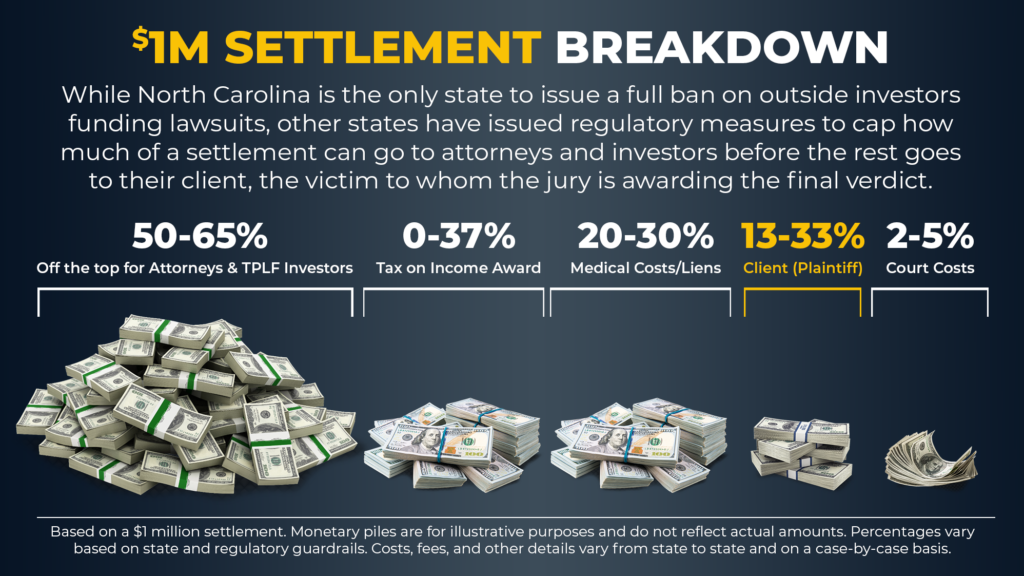
A private investor, sovereign wealth fund, or independent lender pays a plaintiff’s lawsuit expenses in exchange for a cut of the eventual jury award or settlement. The problem in Texas is that there are currently no rules compelling disclosure of who is funding the lawsuit, how much they’re paying, how much of the settlement they’re entitled to receive, or what strings are attached.
The plaintiff does not receive a bill for litigation expenses, which seems advantageous for victims. Conversely, the defendant remains unaware of who is truly orchestrating the proceedings — as do Texas judges and juries. In the absence of adequate regulations and transparency, this $15 billion industry, $20 billion on a global scale, will persist in profiting from lawsuits aimed at Texas companies.
Foreign Funding vs. Texas Businesses
Here’s what should concern Texans: the two largest players in this industry are foreign-controlled. Burford Capital counts an undisclosed sovereign wealth fund as an $872 million financing partner. Saudi Arabia-linked Mithaq Capital is Burford’s second-largest shareholder. Fortress Investment Group has $6.6 billion in U.S. assets tied up in mass tort litigation against American companies, while 68% of the company is owned by Abu Dhabi’s Mubadala Capital, which also operates an investment office in Beijing, China.
Why this matters: Without regulations, foreign capital, some of which is state-directed, may have significant influence over which American businesses get sued, how those suits are pursued, and how long litigation is prolonged for profit. While direct proof that lenders dictate litigation strategy is difficult to establish conclusively, documented disputes, such as the Sysco/Burford Capital lawsuit, reveal that funders can assert substantial control over case decisions, settlement timing, and litigation direction.
Policy Action Across America
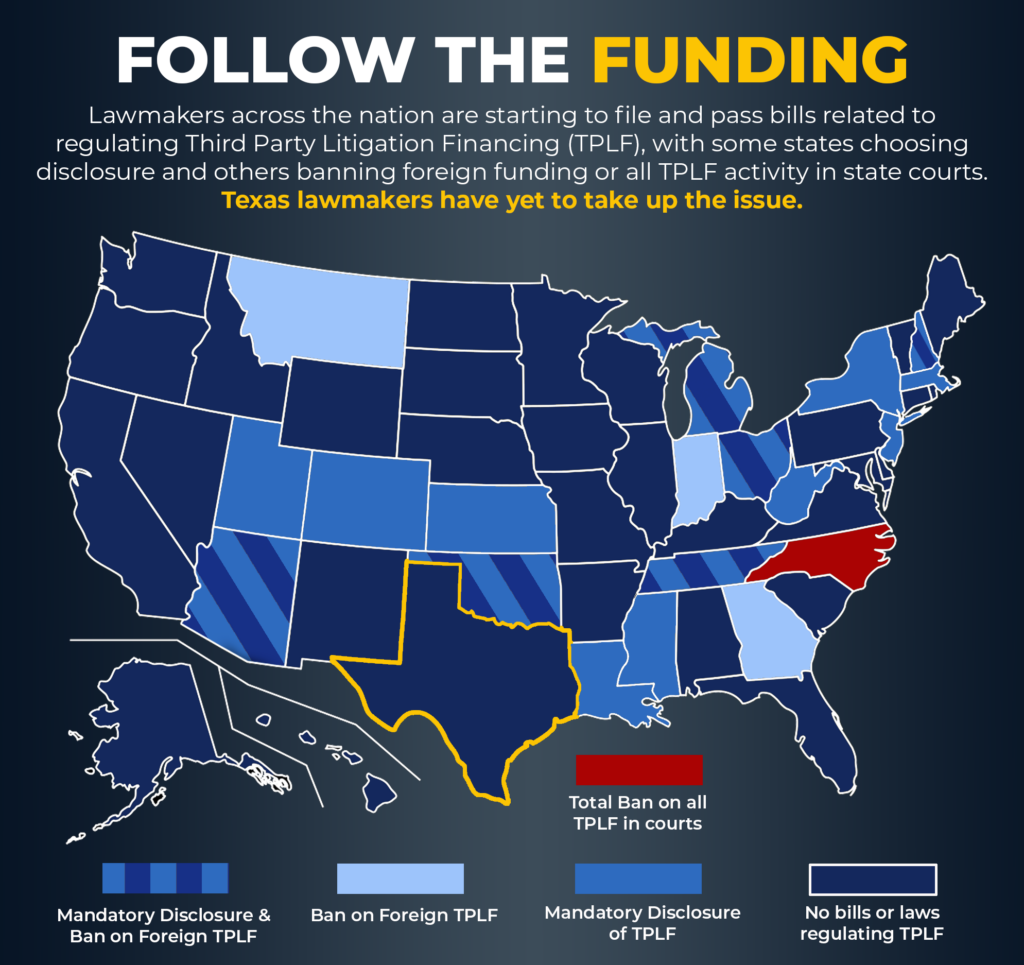
More than a dozen states have already taken action to protect courts by implementing mandatory disclosures. In some cases, the states have banned any foreign-backed investment through TPLF restrictions and disclosure requirements. This year, North Carolina became the first state to ban all forms of TPLF, the strongest proposal to be passed into law. Here’s a broader look at actions taken by lawmakers in different states:
- North Carolina — first-in-the-nation outright ban on lawsuit lending via TPLF (HB 315, June 2026)
- Georgia — mandatory funder registration, foreign-government affiliation ban, criminal penalties (SB 69, April 2026)
- Arizona — bans funding from foreign entities of concern, bars funders from directing case strategy (SB 1215, June 2026)
- Ohio — newly enacted ban on funders domiciled outside the U.S., plus mandates registration and disclosure (HB 105, July 2026)
- Oklahoma — “Foreign Litigation Funding Prevention Act” bars funding from foreign adversaries including Russia and China (HB 2619, November 2025)
- Montana — Foreign Investment in Litigation Financing Act restricts foreign-funder participation (SB 269, May 2023)
- National Picture — see where other states landed on TPLF regulations and what states, like Texas, have yet to take action.
Texas Should Take Action
The Lone Star State built its reputation and economic strength on legal reform. It’s time to close the foreign-funding loophole before this adversarial money finishes rewriting Texas courtrooms from the outside.
Texas already recognized this pattern and acted on it. To strengthen national security and protect Texas’ sovereignty, Senate Bill 17 closed the door on China, Russia, Iran, and North Korea buying Texas land. TPLF is the same threat wearing a different suit. Instead of buying land, foreign actors are buying lawsuits. Other states aren’t waiting. It’s time for Texas to take action to ban foreign-backed TPLF and ensure transparency to protect Texas courts from foreign influence.