
Friends,
Lawsuit abuse adds costs to every Texas family’s grocery bill, insurance premium, and home delivery. As we get closer to November 3, voters are calling on candidates to provide meaningful solutions to the clearly defined affordability crisis:
A Texas mom out $5,579 a year before she’s bought a single thing at the grocery store;
A small business startup finding out that $1 million in liability coverage doesn’t come close to covering a modern jury verdict and could put a litigation target on their back;
A country sitting on more natural gas than any nation on Earth still can’t get it to market because a lawsuit is standing in the pipeline’s way.
There are many causes for the current affordability crisis, but we know at TLR that there is a solution to a significant portion of it – lawsuit reform – which translates into plain dollars and cents. Texans pay for lawsuit abuse at the grocery store. Texans pay for lawsuit abuse at Walmart, Target and online. Texans see their rising insurance costs.
Fortunately, the formula is simple and repeatable: Pass lawsuit reform. Lawsuit abuse stops. Prices stabilize, providing greater certainty and affordability. We’ve done it before. So while trial lawyers find new ways to exploit the civil justice system, legislators need to pass reforms to keep the Texas Miracle working for the people who make it possible.
For the future of Texas,
Ryan Patrick
CEO | TLR
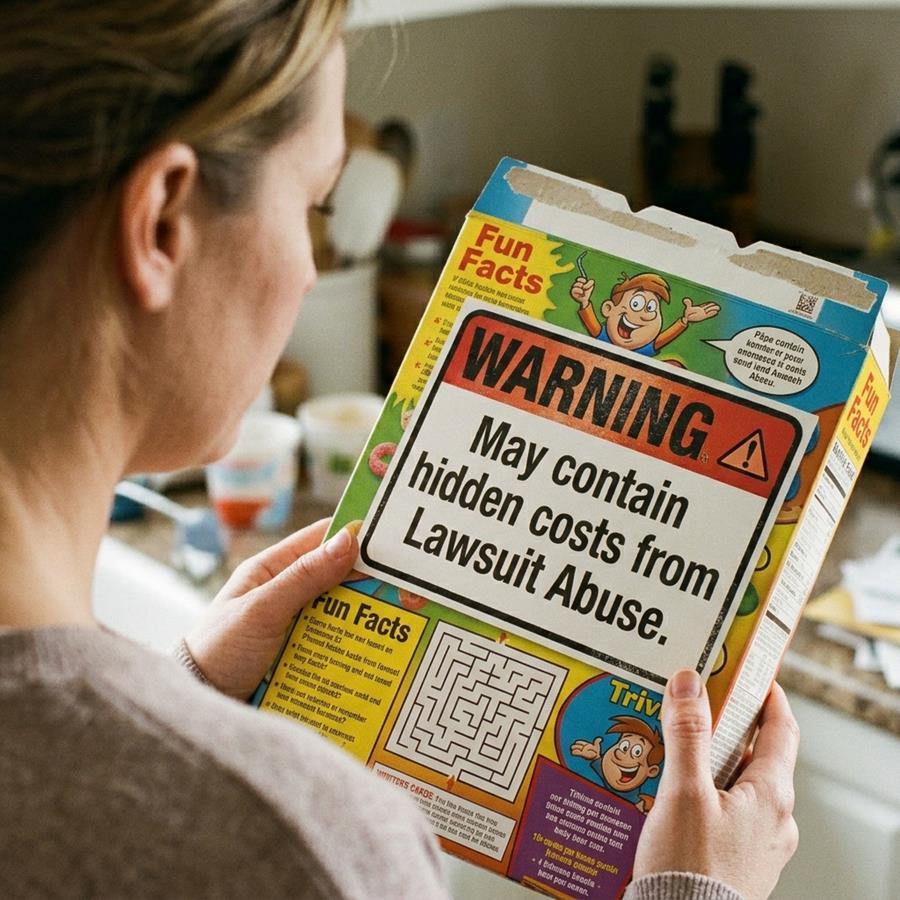
Lawsuit abuse is hidden in the rising costs for everyday goods. The illustration above points to the increased prices at the grocery store being connected to rampant lawsuit abuse that is targeting the companies that help stock shelves and bring goods to your doorstep. The hidden cost is more than $5,500 per US household.
America’s Legal System Abuse Is Part of Our Hidden Cost-of-Living Crisis
Legal system abuse isn’t a courtroom problem; it’s a profit center. Americans are footing the bill and starting to connect the pain in their wallets to the seemingly endless string of billboard lawyer ads. In a new op-ed, Jenn Pellegrino lays out the mechanics: staged car crashes engineered for insurance payouts, misleading lawyer billboards designed to manufacture claims, and medically unnecessary procedures billed straight into a lawsuit’s damages calculation. The Institute for Legal Reform puts the price tag on American small businesses alone at $160 billion a year — a cost that ultimately lands on the customers and employees those businesses support.
Pellegrino’s fix isn’t complicated: shine a light on who’s actually funding these lawsuits. She points to Third-Party Litigation Funding transparency requirements, the Protecting Our Courts from Foreign Manipulation Act, and the Tackling Predatory Litigation Funding Act as disclosure rules that let juries see who’s really profiting when a lawsuit goes nuclear.
As candidates race to offer alternative solutions to affordability problems, Texas is losing ground to other states that are proactive on lawsuit reform. We love to tout our fantastic growth in Texas, but other states want a piece of us. Florida residents saved $3 billion on home and auto insurance costs and still paid more than Texans, but for how long? Florida passed the solutions mentioned above and saw tangible savings. The question is whether Texas lawmakers step in before it’s too late, or continue to allow lawsuit abuse to put pressure on Texans’ paychecks.
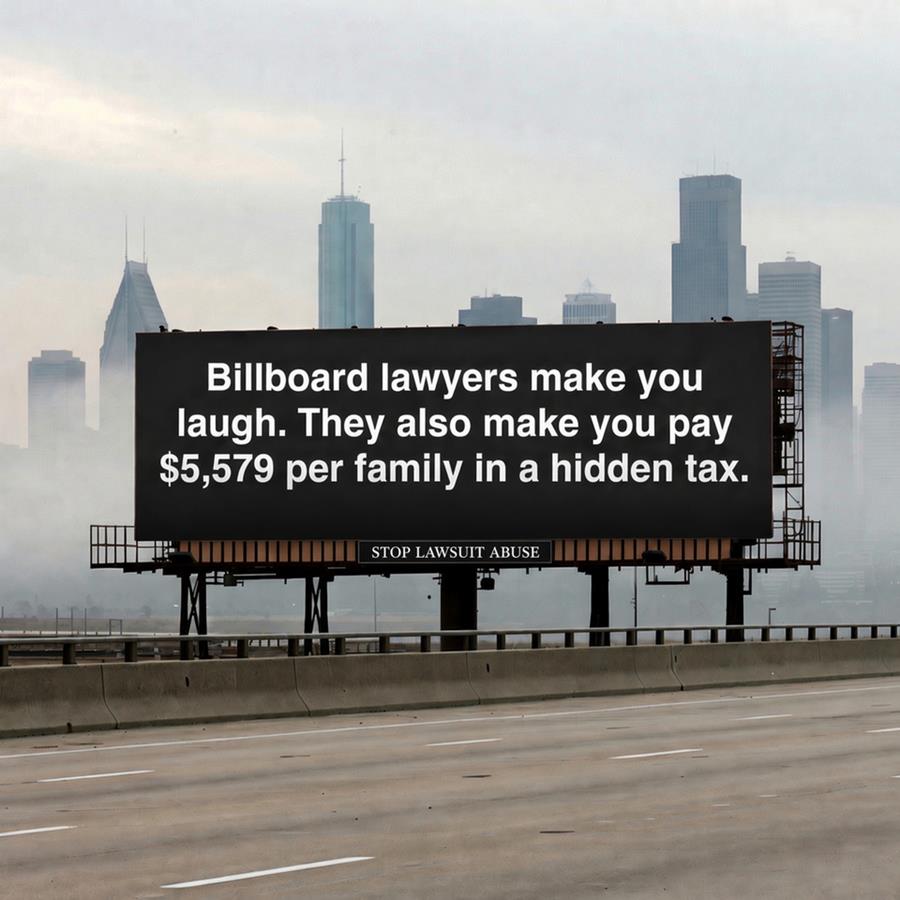
Billboard ads for lawyers are a regular part of our daily commutes, but do they have to be? More and more advocates are calling out billboard lawyers for the schemes used in courtrooms to drive up verdicts and settlements in lawsuits. It begs the question: who is the last one laughing when lawsuit abuse gets out of control?
How Trial Lawyers Stick Your Family With a $5,579 Hidden Tax
Texans can feel the effects of lawsuit abuse, yet finding the culprits can be a challenge. Another recent op-ed puts a hard number on the hidden cost: $5,579 per family, per year, buried inside higher retail prices, inflated insurance premiums, and padded healthcare costs that trace straight back to America’s litigation system. It’s the hidden tort tax TLR has been warning Texans about for years, now with a receipt attached.
We’ve shown you the system and examples of law firms that have used staged accident rings to create a pipeline for frivolous lawsuits. But what about the other lawsuits? This op-ed draws a clear line between billboard lawyers driving lawsuits with medical billing fraud, TPLF, and other schemes hidden from judges and juries.
As voters across the country have raised concerns about affordability, lawmakers have responded with several major lawsuit-reform victories. In Texas, however, a contingent of lawmakers blocked reforms delivered by states like Florida and Georgia. Texas stalled at the finish line, and the costs keep adding up for every Texas family and business.
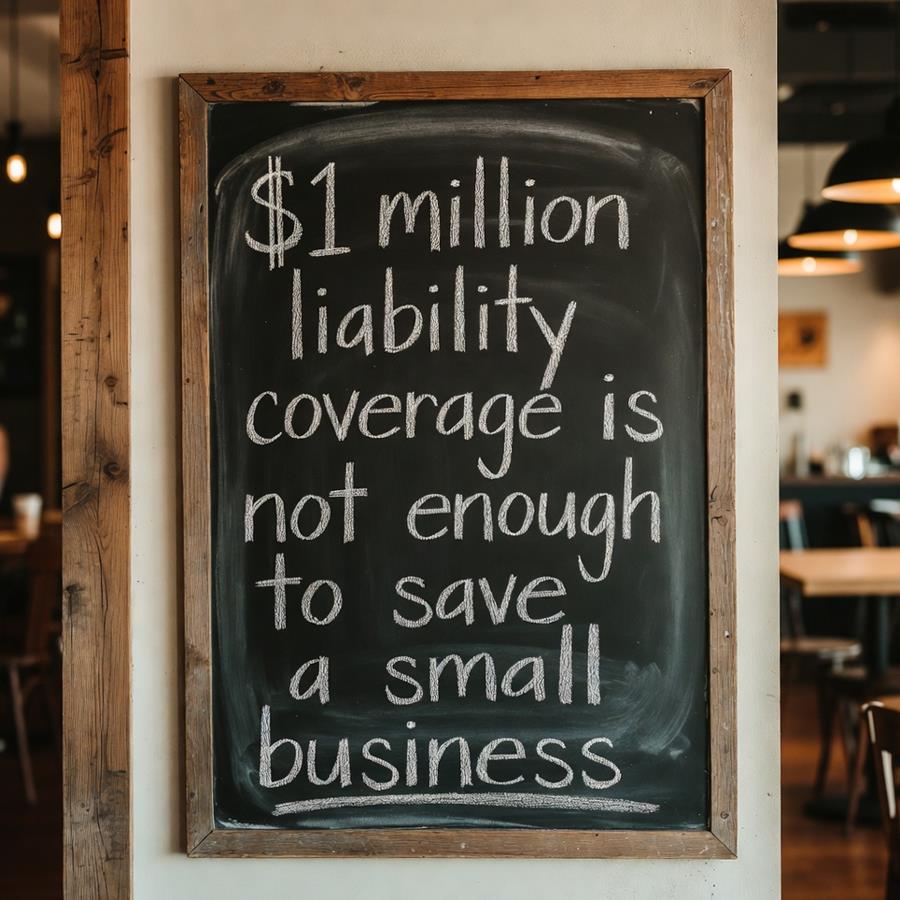
America is the land of opportunity, but that dream is getting harder and harder for entrepreneurs to reach. Rising liability coverage costs are pricing out new businesses before they can get off the ground. And with verdicts continuing to climb, outpacing inflation and every other basic economic indicator, the amount of coverage needed to protect small businesses is getting harder to justify.
With Jury Verdicts Rising, Small Businesses Feel the Most Pain from Rising Insurance Costs
Most small businesses in Texas carry $1 million in general liability coverage. That used to be a reasonable cushion, but it isn’t anymore. According to MoneyGeek’s analysis of nuclear verdict trends, a standard $1 million policy now covers just 10% of a $10 million verdict — and only 2% of the $51 million median nuclear verdict recorded in 2024. Even stacking on a second $1 million in umbrella coverage still leaves a small business short of 15% of the average award from a lawsuit.
The trend line is the real warning sign: nuclear verdicts jumped from 89 in 2023 to 135 in 2024 — a 52% increase — totaling $31.3 billion in payouts, per Marathon Strategies. And small businesses aren’t spectators in this fight: companies under $10 million in revenue generate only 20% of U.S. commercial revenue but absorb 48% of the country’s commercial tort costs. That’s a convenience store or a family-owned distributor paying roughly $35 in tort costs for every $1,000 in revenue. For the country’s largest corporations, the comparable figure is about $5 per $1,000. Jury surveys show it isn’t even because small businesses are seen as more at fault — 25% of surveyed jurors said they’d award $10 million or more against a small business, not far behind the 30% who’d hand down the same verdict to a large corporation.
Texas prides itself on our independent spirit; our ability to take nothing and make something recognized around the world. The Alamo. The Dallas Cowboys. Buc-ee’s. But even the strongest spirit can’t overcome a straightforward math problem — $1 million isn’t enough to save a small business from an abusive lawsuit. It’s a problem that’s getting worse every year, and if the Legislature doesn’t act, the next great innovation won’t come from Texas. It’ll get its start in another state, where the American Dream is still within reach.
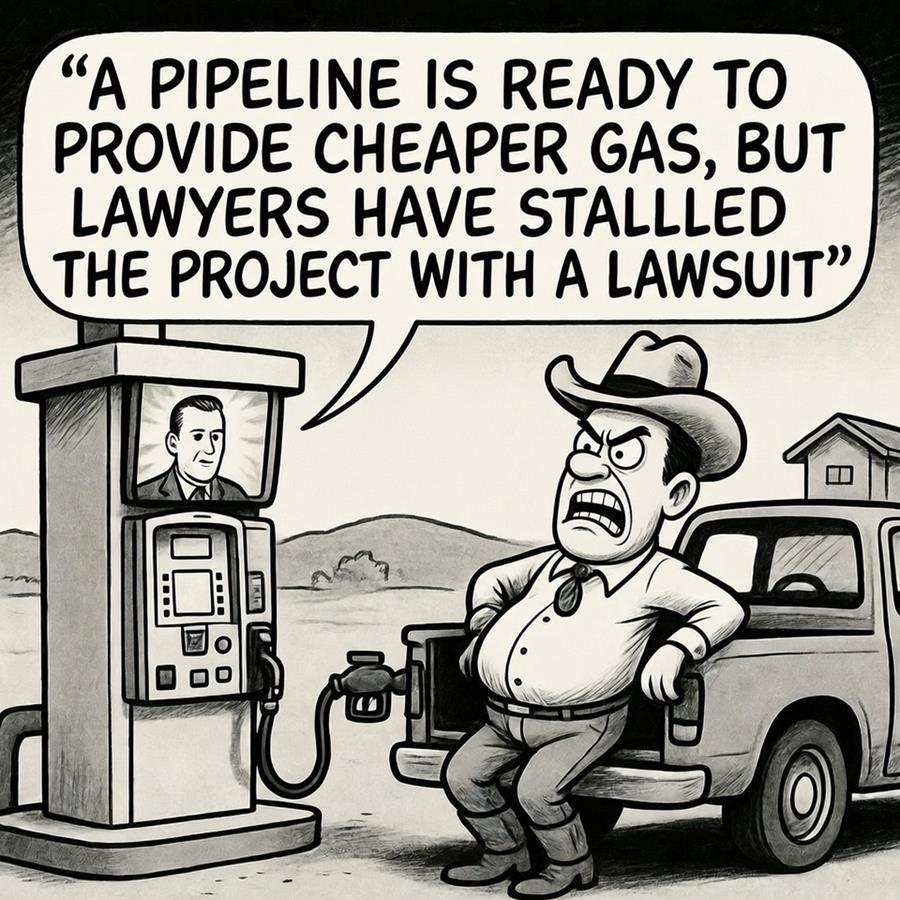
Gas prices are out of control, and candidates are pushing lots of ideas with no long-term solutions. Meanwhile, lawsuit abuse is keeping Texas from building the infrastructure to reduce the cost of transporting oil and gas, which would strengthen production and help lower the price at the pump and in Texas electric bills.
America Doesn’t Have an Energy Shortage. We Have a Lawsuit Problem.
America is the world’s largest natural gas producer. So, why can’t Texans count on cheap, reliable energy? Rep. Laurel Lee’s op-ed names the real bottleneck: not supply, but litigation. Federally approved pipeline projects that were reviewed, permitted, and ready to build are getting tied up for years by lawsuits designed to do one thing: delay a project until it becomes too expensive to finish.
Lee’s answer is to rein in the judicial review mechanisms trial lawyers and activist groups use to weaponize the courts against energy infrastructure that’s already cleared every regulatory hurdle. Texas knows this playbook. It’s the same one billboard lawyers run in the courtroom — just applied to a pipeline instead of a car wreck.