
Friends,
It’s the Friday before early voting. On Monday, around 500,000 Texas voters are expected to head to the polls and cast their ballot. The energy building toward Election Day—November 3, if you haven’t gotten a text message reminder in the last 30 seconds—is hard to shake after months of block walking, candidate forums and fundraisers. It’s a season unto itself for many Texans.
The one thing I don’t do is make election day predictions. No matter what we think polls say, Texans still have to show up and vote. And on November 4 we still wake up in the greatest state in the greatest country the world has ever known.
And the work to keep the Texas Miracle growing will continue. The policy part of TLR is well underway preparing for the 2027 legislative session. The pre-filing period for members of the 90th Legislature starts in 24 days and they convene in 88.
This week’s roundup highlights how lawsuit abuse is spreading, warnings from consumer protection advocates, and why we must stay vigilant to stop lawsuit abuse from eroding the Texas Miracle.
I’ll look for y’all on the campaign trail and see you around the Capitol soon.
For the future of Texas,
Ryan Patrick
CEO | TLR

Before we get into this week’s round-up, a quick reminder: the General Election is coming up soon, and Early Voting is right around the corner. Don’t get left behind this election cycle. Make a plan, and cast your ballot to Keep Texas Strong!
Here are some helpful links to help you cast your ballot by Tuesday, November 3.
Make a Plan, Cast Your Vote
Confirm You’re Registered
Mailing Your Ballot? Track your ballot
Voting in person? Find Your Polling Place
Pick a Date to Vote
EARLY VOTING October 19-30
ELECTION DAY Tuesday, November 3
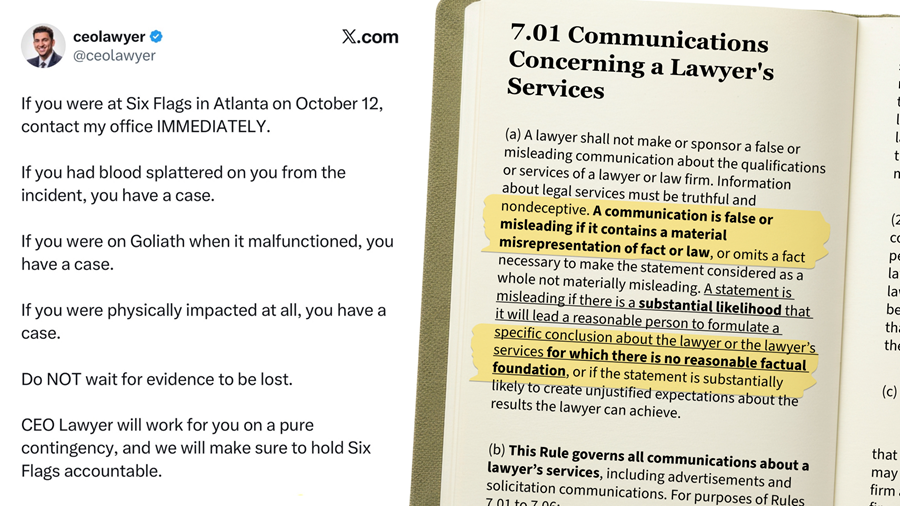
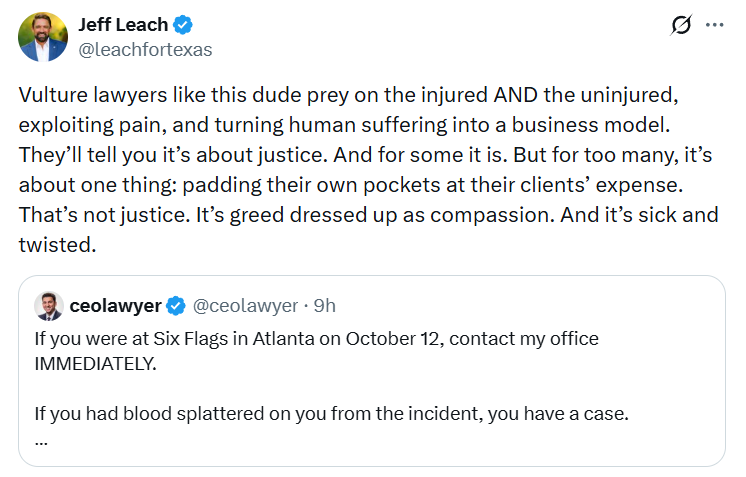
Georgia-based lawyer Ali Awad is in hot water with one Texas lawmaker after posting a “sick and twisted” message to bystanders and guests who witnessed the tragic incident at Six Flags in Atlanta earlier this week. State Rep. Jeff Leach (R-McKinney) posted the following response to “The CEO Lawyer”:
On Wednesday, Legal Newsline published an article about the exchange and highlighted how the Georgia lawyer—whose law firm has offices in Houston, Carrollton, Dallas, Fort Worth, San Antonio, and El Paso—is drawing rebuke from others for violating Rule 7.01 under the Texas State Bar’s Disciplinary Rules of Professional Conduct. Investigators have not said what went wrong at Six Flags in Atlanta. Awad violated the rule by stating a fact “for which there is no reasonable factual foundation.”
Rep. Leach called it “greed dressed up as compassion.” This billboard lawyer’s callousness reinforced our mission:
“Ambulance-chasing lawyers like this are why TLR exists.”
— Ryan Patrick, CEO, TLR

About a Dozen Investors Pooled $2 Billion To Fund Lawsuits Attacking American Companies in Court, Taking the Profits
Last week’s newsletter highlighted this breaking news item: a major lawsuit funder had secured $1 billion in investments for a second time, deploying $300 million of those new funds already into lawsuit investments. The headline clearly signals a growing appetite for betting on lawsuits.
Here’s the biggest problem: Omni won’t disclose who is behind the money. The company doesn’t name its funders, and its CEO describes them broadly as “very large” investors who average more than $100 million each in giving—and nearly all of them are repeat customers, with nine of the apparently 10 first-round funders returning to pony up again. That’s almost $200 million each, for $2 billion total in Omni Bridgeway’s global lawsuit funding portfolio. It means the investment, funding lawsuits, was too good to pass up for a second round.
Hidden funders profit from lawsuits that attack Texas companies and use the courts as a profit center. Texas currently lacks effective limits on third-party funders, and the warning signs from other states show why lawmakers should act in 2027 to put up guardrails in state law. North Carolina recently banned this practice and more states are requiring funder disclosure.
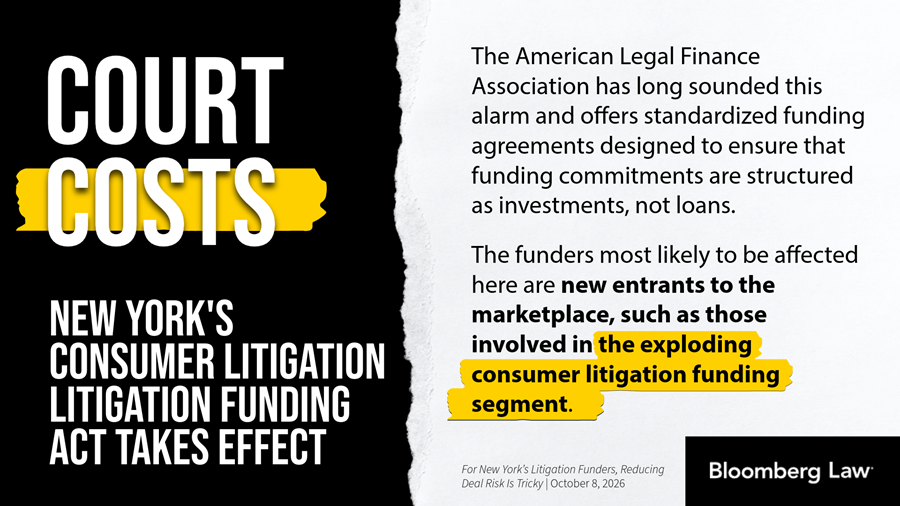
Profiting off Plaintiffs: High-interest predatory loans cannot be hidden as lawsuit investments. A New York appeals court ruled that a third-party funder tried to saddle a plaintiff with a 19% interest rate, well above state law for loans. The case, along with the implementation of The Consumer Litigation Protection Act, shows that New York has installed proper guardrails to protect plaintiffs from third-party funders masking loans as investments.
The American Legal Finance Association warns of a larger problem: “The funders most likely to be affected here are new entrants to the marketplace, such as those involved in the exploding consumer litigation funding segment.” New York chose to act and protect consumers from predatory lenders. Shouldn’t Texas take similar steps?
Want to read more? Investor money is showing up in nursing home lawsuits too. Investor-backed claims are associated with a 60.5% increase in payouts, 140% longer resolution times, and a 35.7% drop in the likelihood of a settlement, according to a report published in May. Georgia now requires those funders to register with the state, and a judge can limit their share of a jury award. Texas has few guardrails for lawsuit funders.
Houston Trial Lawyers Plead Guilty to Medical Billing Fraud, Skimming Settlement Dollars from Victims
Houston attorney Clyde J. Moore pleaded guilty in 2025 to conspiracy to commit mail fraud and filing a false tax return. A firm member, Mark Broussard, had already pleaded guilty to the same charges. Prosecutors say the scheme inflated medical costs and told clients the firm had paid providers more than it had, shrinking their settlement shares. Fraud losses: about $2.4 million. Where it went: two Ferraris and private school tuition.
Personal injury attorney convicted of obstructing justice
A federal jury convicted Houston attorney Richard Plezia in 2023 of conspiracy, false statements, and falsifying a record. Prosecutors say he lied to authorities about payments to a case runner, then handed a grand jury falsified documents to back up the story. About $500,000 passed through his business account from another attorney who was illegally buying personal injury cases. The broader case-running scheme caused an estimated $4.3 million tax loss to the IRS. The court largely upheld the conviction on appeal in 2024.
Lawyer Who Misapplied Client Money Gets 10 Years After Probation Revoked
Burt Lee Burnett pleaded guilty to misapplying client funds and got deferred adjudication and a $200,000 restitution order. Then the violations piled up, including repeated positive drug tests. A Taylor County judge revoked his probation and sentenced him to 10 years in prison, and the Eleventh Court of Appeals upheld the sentence in December 2022.
Dallas Lawyer Sentenced to 25 Years for Stealing Settlement Dollars
Disbarred Dallas attorney Thomas Corea took money from some clients’ settlements to pay other clients he owed. When the money ran out, not everyone got paid. More than 40 former clients filed claims. One couple’s $225,000 drug-company settlement reportedly netted them $5,000. A state judge sentenced him to 25 years in prison.