
Friends,
Billboard lawyers face a new problem: outside money behind lawsuits is getting harder to hide, and Texans aren’t the only ones asking questions anymore.
Last week, the Texas Supreme Court sent Third-Party Litigation Finance (TPLF) disclosure rules back to its advisory committee — a clear signal the justices weren’t satisfied when the panel declined to act back in August. The justices want a real proposal on the table by December — before lawmakers convene in January.
In Washington, that same question just gained support from nearly 200 businesses. Major employers from across the country told the federal Advisory Committee on Civil Rules that the silence around who’s bankrolling lawsuits against them is “inexplicable.” Legal experts and some of America’s largest job creators are asking for mandatory disclosure of funders’ names and agreements in every federal civil case whose rules are separate from state courts. US Department of Justice officials have warned for years that TPLF poses national security risks to American companies.
And in Congress, Texas’s own Rep. Troy Nehls (R-TX-22) filed the bipartisan Stop Auto Fraud Act of 2026, making staged “crash for cash” collisions a federal crime for the first time — with penalties up to life in prison when someone dies chasing an insurance payout. “Bad actors across the country are deliberately causing, staging and fabricating car wrecks,” Nehls said. “It’s the hardworking American families who end up paying the price with high insurance rates.”
Affordability will be a policy priority in the 2027 Texas Legislature. The question is whether lawmakers will act to stop lawsuit abuse driving up costs for everyone.
For the future of Texas,
Ryan Patrick
CEO | TLR
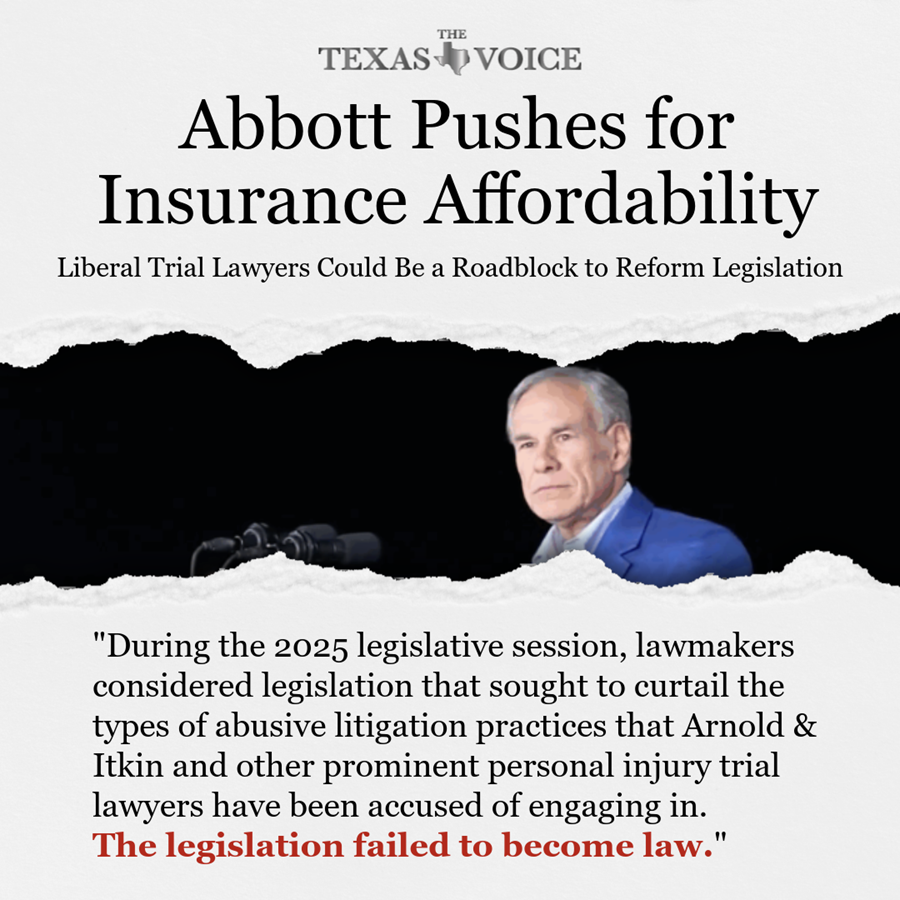
Governor Abbott Touts Affordability. Will Billboard Lawyers Block His Agenda in 2027?
Governor Abbott is making insurance affordability the centerpiece of his Keep Texas Affordable push — homeowners’ premiums are up 79% over six years, and he’s ordered the Texas Department of Insurance to stand up a fraud task force to dig into what’s really driving claims costs. Florida, Georgia, and New York have already shown reform works: USAA alone returned nearly $1 billion to Florida policyholders after that state acted. So did Progressive. A recent study showed lawsuit reforms saved Florida ratepayers about $3 billion on home and auto insurance costs in 2025.
Texas hasn’t gotten there yet, but Governor Greg Abbott has made clear affordability is a priority. There’s one catch, and it’s a big one—verdict-hungry trial lawyers will do anything to block reforms that will improve affordability.
Defense attorneys are fighting back, borrowing a page from the trial attorney’s playbook by suing alleged fraudsters for financial damages. Court filings in Houston accuse Houston personal injury firm Arnold & Itkin of using billing arrangements with medical providers to inflate damages in their cases. Fraudulent and inflated medical billing within personal injury cases are a critical target for reform in Texas. And to stop this reform, A&I is putting real money behind keeping the status quo. They donated $300,000 to a liberal PAC in 2024, and later set up a new $10 million operation aimed at influencing Republican primaries. Why? Because medical billing fraud in Texas courts leads to massive verdicts and/or settlements in lawsuits.
Dr. Mark Hanson, a retired Arlington optometrist, lays out the fix in a sharp op-ed: Texas medical malpractice reform 20 years ago cut claims by nearly two-thirds and spurred 18,000 more doctors to practice in the state proving reform works when lawmakers finish the job. His prescription for 2027: let juries see what medical care actually costs, not the inflated bill. Florida did it in 2023; Georgia followed in 2025 and even New York delivered reforms this year. Rates have come down significantly in Florida and Georgia and New York is preparing for its first round of cuts following reforms targeting insurance fraud.
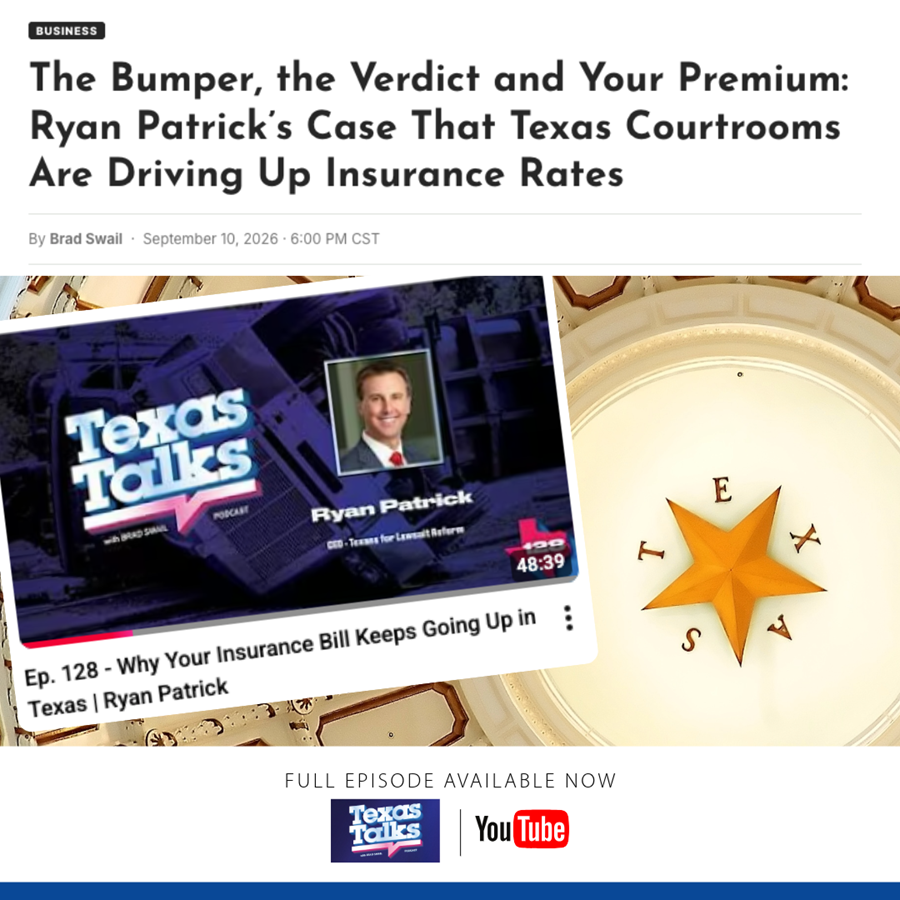
Medical Billing Fraud, TPLF, and Staged Accidents: Ryan Patrick joins ‘Texas Talks’ for Wide-Ranging Discussion
I recently sat down with Texas Talks to walk through a number that should stop you in your tracks: nearly 80% of Texas traffic accidents end up in litigation, compared to roughly 50% in California. That’s not a coincidence — it’s an incentive structure, and Texans are paying for it. Full-coverage auto premiums here are up almost 58% in four years, to an average of $2,470.
Nuclear verdicts — jury awards over $10 million — jumped 40.7% nationally in 2025; Texas alone racked up 29 of them, totaling roughly $3.3 billion. Those verdicts don’t stay contained to one courtroom. Insurers price risk statewide, so a handful of counties end up setting the bill for everyone. What’s the fix? Require juries to see itemized medical bills alongside what doctors actually collect day to day, plus tighter rules on negligent entrustment claims and a standalone staged-collision offense.
Click here to watch the full episode of Texas Talks on YouTube.
Third-Party Funding of Lawsuits Gains More Scrutiny as Texas’ Top Judges Ask Panel to Reconsider Potential Rule Changes
Third-Party Litigation Finance (outside investors give money to law firms to pursue lawsuits and take a cut of the verdict or settlement) is happening in Texas. What’s less clear is whether Texas courts are uniformly providing transparency and accountability around TPLF’s use in lawsuits.
In August, the Texas Supreme Court’s advisory committee declined to recommend any changes to litigation-finance disclosure rules. The justices told the panel to go back to the table and provide actionable recommendations to consider implementing rather than dismissing the need for new rules on accountability and transparency for outside funders. The justices sent the committee back to work, weighing options that could include a full ban, limited rules barring foreign investments, or full disclosure in proceedings.
Texas is already late to the fight. North Carolina recently banned third-party litigation funding outright. Ohio now requires funders to register with the state and disclose their agreements to the attorney general. Texas’s own Business Courts already require this kind of disclosure — modeled on federal Fifth Circuit standards — specifically to catch judicial conflicts of interest. The advisory committee votes on a real proposal in December, just before lawmakers return to Austin for a regular legislative session. We’ll be watching, and pushing for added transparency and accountability in Texas courts.